We called 13 San Diego plumbers. One turned the job down, and the one who named a price wanted $400.
Thirteen plumbing listings in ZIP 92139 were dialled at 4:22 PM PT on a Friday. Nine calls show as completed but only five reached a person, one of those five turned the job down, and exactly one named a figure: a $400 after-hours service fee.
The job was created at 4:21 on a Friday afternoon, and the calls went out less than a minute later. Boocki found nineteen plumbing listings in ZIP 92139, in southeast San Diego, dialled thirteen of them, and asked each the same two things about a clogged toilet that was needed as soon as possible: could they come out, and what would it cost. Nine of the thirteen calls came back marked completed, but only five reached a person. One of those five said they were fully booked and offered to send the job elsewhere, and exactly one named a number: a four hundred dollar after-hours fee to come out that evening.
- 13
- called4:22 PM PT, one burst
- 5
- reached a personof the thirteen dialled
- 1
- turned the job downfully booked, and said so
- 1
- named a figure$400 to come out
How to read this
Seven phrases carry the piece, and the first three are the ones a reader is most likely to blur together.
- Recorded as completed: the status on the call row in our own database. Nine of the thirteen calls carry it. It is not a human count, and four of the nine are not people.
- Reached a person: a human at the provider’s end spoke, read from that call’s own summary. Five of the thirteen. This is the number that describes the job.
- Reached a machine: the call completed against something that was not a person: an automated menu (call 4), a virtual assistant that took a message and promised a callback (call 6), or a voicemail box (calls 7 and 10). Four calls, and every one of them counts as completed.
- Confirmed they could come: the product’s availability field was set to true because the provider said so. Five calls, but one of those five is the virtual assistant, so only four people actually said it.
- Turned the job down: the availability field was set to false because the provider said they could not take it. One call, and the first time this series has recorded a No.
- Same-day window: a provider gave a time they could be there that Friday evening. Three of the four people who could come did.
- Named a figure: a provider said a dollar amount out loud. One of the thirteen, and it was a fee to come out rather than a price for the repair.
The claim being tested
The search phrase for this job was emergency plumber toilet clog, and the job was marked as soon as possible. It was also placed late: created at 4:21 PM on a Friday and dialled a minute later, which put the whole run in the back half of the working day, when the offices that answer the phone in the morning are close to closing. What follows is what thirteen emergency plumbing listings on the southeast side of San Diego actually answered at 4:22 on a Friday afternoon.
Nineteen listings came back from the search. Thirteen were dialled, which is a choice rather than a limit: this job did not dial the whole list. The six that were not called are part of the denominator here and appear in the funnel and the arithmetic, because “thirteen called” means nothing without “nineteen found”.
The thirteen calls, one by one
Everything below reconciles to this table. No provider is named: the recordings carry business names, the homeowner’s street address and a callback number, so the call numbers are the identifiers here. The “Confirmed” column is the product’s own availability field: Yes is a provider who said they could come, No is the one who said they could not, and None is a call that never produced an answer either way. In the price column, None means nothing was said about money at all and No figure means a provider addressed the price without naming one.
| # | What happened | Length | Confirmed | Price |
|---|---|---|---|---|
| 1 | A person answered, offered after-hours service that evening for a fee, and asked the homeowner to call directly | 1:01 | Yes | $400 |
| 2 | A person answered and confirmed they handle emergency clogs, then the call ended before a time or a price | 0:51 | Yes | None |
| 3 | Nobody picked up | 0:00 | None | None |
| 4 | An automated menu answered; the appointment option was pressed and the call ended before a person | 0:36 | None | None |
| 5 | A person answered, confirmed they could come, and offered a window of two to three hours; no price | 1:34 | Yes | None |
| 6 | A virtual assistant answered, could not book or quote, took the job details, and promised a callback | 5:19 | Yes | No figure |
| 7 | A voicemail box took the call and the message was left | 0:59 | None | None |
| 8 | A person answered, said they were fully booked, and offered to refer the job elsewhere | 0:53 | No | None |
| 9 | A person answered, offered three windows that same day, and said a technician prices the job on site | 3:22 | Yes | No figure |
| 10 | A voicemail box took the call and the message was left | 0:07 | None | None |
| 11 | Nobody picked up | 0:00 | None | None |
| 12 | Nobody picked up | 0:00 | None | None |
| 13 | Nobody picked up | 0:00 | None | None |
Two things to note before the summary. The Confirmed column has a No in it for the first time in this series, and it is the honest kind: call 8 did not hang up or ignore the request, they said they were fully booked and offered to point the caller at somebody who was not. And calls 11 to 13 rang out in a second wave about five minutes after the first ten, because the workspace only places what the concurrency limit fits and dials the rest as slots free up. All three of the late calls answered nothing.
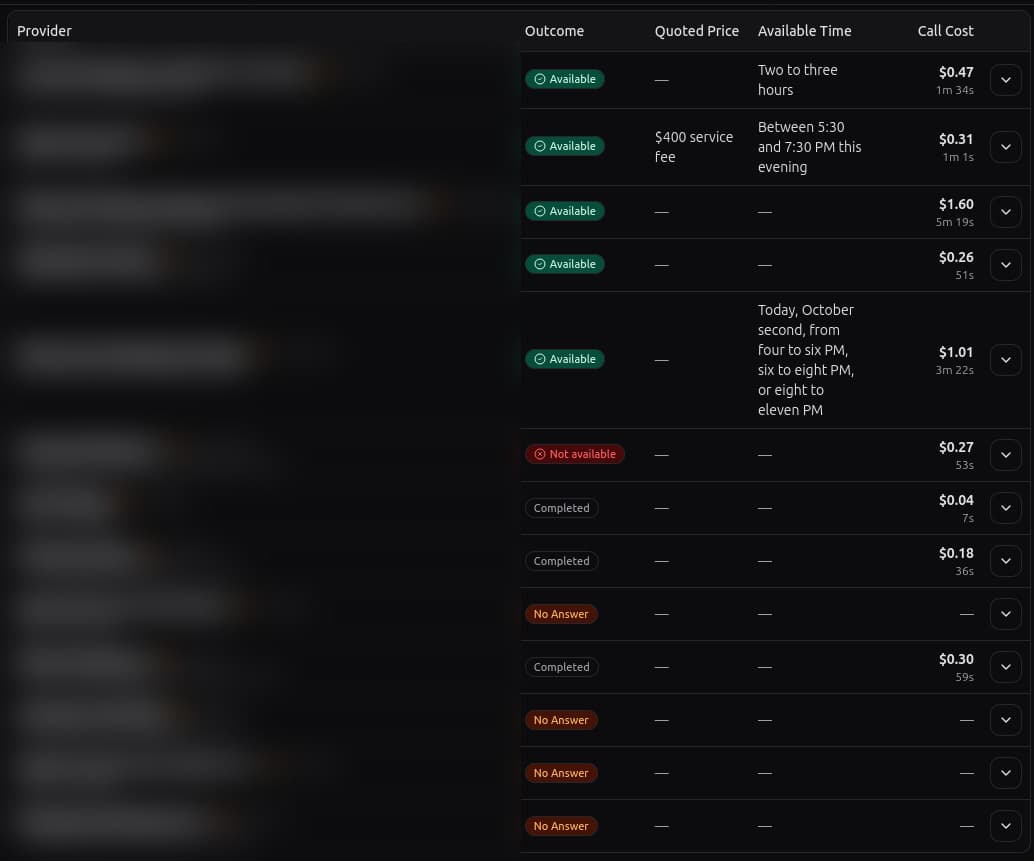
The nine calls our own records called completed
This is the first trap in the numbers, and on this job it is a bigger one than usual. Nine of the thirteen calls carry a status of completed in the Boocki database, but only five of those nine reached a person. The other four reached machines: an automated menu, a virtual assistant that took the details and promised a callback, and two voicemail boxes. They count as completed because the call had a result and something was delivered on it, which is what that field is for. It is not a people counter.
| # | Recorded | What the call actually was | Length |
|---|---|---|---|
| 1 | completed | A person spoke | 1:01 |
| 2 | completed | A person spoke | 0:51 |
| 4 | completed | An automated menu answered, and no person came on | 0:36 |
| 5 | completed | A person spoke | 1:34 |
| 6 | completed | A virtual assistant answered, and no person came on | 5:19 |
| 7 | completed | A voicemail box took a message | 0:59 |
| 8 | completed | A person spoke | 0:53 |
| 9 | completed | A person spoke | 3:22 |
| 10 | completed | A voicemail box took a message | 0:07 |
Nine decomposes exactly: five calls where a person spoke, and four where a machine answered instead. Call 6 is the interesting one. It ran for five minutes and nineteen seconds, the longest call in the job, against a virtual assistant that could not book and could not quote, took the job details down, and promised a callback from a live team member. On the status field that is a completed call, the longest of the thirteen. Against the question the job is actually asking, it is a promise, not an appointment.
The funnel
The same thirteen calls, narrowed seven times. Every row is the sum of rows in the master table above, and the “Calls” column says which, so nothing here is an orphan number.
| Step | Calls | Count | Share |
|---|---|---|---|
| Plumbing listings found | n/a | 19 | n/a |
| Called | 1 to 13 | 13 | 100% |
| Recorded completed | 1, 2, 4 to 10 | 9 | 69% |
| Reached a person | 1, 2, 5, 8, 9 | 5 | 38% |
| Confirmed they could come | 1, 2, 5, 9 | 4 | 31% |
| Offered a same-day window | 1, 5, 9 | 3 | 23% |
| Named a figure | 1 | 1 | 8% |
Read the third row against the fourth. Both describe the same thirteen calls, they differ by four, and the four are calls 4, 6, 7 and 10: an automated menu, a virtual assistant, and two voicemail boxes. If this page had a single number on it, it would be the fourth row, because the third one is a statement about our database rather than about San Diego. Note too that the availability field reports five calls as able to come, while only four people actually said so: the virtual assistant on call 6 set the field as well.
The five people who answered
Five calls reached a human being. Four said they could take the job and one said they could not. Three of the four who could take it attached a time to the yes, and all three of those times were that same Friday evening. Whether that is the hour or the luck of this particular list, one job cannot say. What it does say is that an afternoon run is not automatically a worse one, and this one hit an unusual run of answers that ended against a machine instead of a person.
| # | What they said | When | Price |
|---|---|---|---|
| 1 | After-hours service that evening, and the homeowner should call directly to book it | 5:30 to 7:30 PM | $400 |
| 2 | Confirmed they handle emergency clogs, and the call ended before a time or a price | None | None |
| 5 | Could come, with a wait of a couple of hours | two to three hours | None |
| 8 | Fully booked, and offered to refer the job elsewhere | None | None |
| 9 | Three arrival windows that day, with the technician pricing it on site | 4 to 6, 6 to 8, 8 to 11 PM | No figure |
Call 8 is the one to read twice. Asked whether they could help with an emergency clog, the person who answered said they were fully booked and offered to send the caller to someone who was not. That is a No in the availability column, and it is the first one this series has recorded, but it is not a wall and not a door closing: it is a business telling the truth about its own schedule and then helping anyway. Of all the things a homeowner would want to know earlier, a fast and honest “not us, try them” is worth more than a voicemail that promises a callback nobody makes, which is what four other calls in this job produced.
The one figure anybody named
One provider of the thirteen said a dollar amount out loud, and it was the first call of the job. Asked what it would cost to clear a toilet that evening, the person who answered explained that the job was outside normal hours and then named the fee to come out:
It would be a four hundred dollar service fee for us to come out this evening.
That is a service fee to attend, not the cost of the repair, and the same provider would price the actual fix on top of it once they saw the toilet. It is the highest figure any provider has named in this series, and it is also the number least comparable to the others, because it buys a visit rather than a job. Every other provider who reached the price question refused to answer it over the phone. Call 9 put the reason in one sentence:
For cost, pricing depends on the specific issue, and the technician can assess it and provide an accurate estimate.
So the entire price answer from this job is one fee, from call 1, and two deferrals, from calls 6 and 9. Two more calls reached the question and ended before anyone answered it (calls 2 and 5), and one call was a decline. The deferrals are not a refusal to help. They are the same structural fact an earlier job the same day turned up at the other end of the clock: an emergency clog cannot be priced from the other end of a phone, because a plumber has to see whether it clears with an auger or needs the fixture pulled. The $400 sits above that fact rather than contradicting it. It is the one part of the price a business can quote without looking at the toilet, which is the part that depends only on the clock and not on the job.
The arithmetic
The job cost four dollars and forty-one cents. The one figure it was quoted was four hundred, so that single fee is roughly ninety times what the entire run of thirteen calls consumed. That is the arithmetic of a search where the only price on offer was an emergency premium, most of the completed calls ended against a machine, and one provider turned the job down.
| Metric | Value |
|---|---|
| Plumbing listings found | 19 |
| Calls placed | 13 |
| Talk time | 14 min 42 s |
| Longest call | 5:19 (call 6) |
| Shortest call | 0:00 (calls 3, 11 to 13) |
| Recorded as completed | 9 |
| Reached a person | 5 |
| Confirmed they could come | 4 |
| Turned the job down | 1 |
| Same-day windows offered | 3 |
| Figures named | 1 |
| Total charged | $4.41 |
| Average per call | $0.34 |
| Average per person reached | $0.88 |
| Average per same-day window | $1.47 |
The thirteen durations sum to 882 seconds, which is the 14 min 42 s in the table: 1:01 + 0:51 + 0:00 + 0:36 + 1:34 + 5:19 + 0:59 + 0:53 + 3:22 + 0:07 + 0:00 + 0:00 + 0:00. The $4.41 is what the job’s ledger rows settle to, not a sum of per-minute estimates, and it covers the nine calls a person or a machine answered rather than all thirteen. The other three rows are that same money divided by thirteen calls, by the five calls that reached a person, and by the three calls that offered a same-day window.
What we would change next time
- Dial the whole list. Nineteen listings came back and thirteen were called, so six providers were never asked. If the run is going to lean on machines answering, the answer is more dials, not fewer, and the denominator of this post should have been nineteen.
- Count the machines separately in the board.Nine completed and five human is a gap of four, and a product that shows a customer “nine calls done” while four of them were a menu, a bot and two voicemail boxes is telling them less than they paid for. The status field is correct; the summary built on top of it is not.
- Ask for the visit fee, not the repair price. The one figure that arrived was the fee to come out, which is the part of a price that does not depend on seeing the job. Every provider could answer that question, and most could answer it in the same breath as their availability, so a script that asks for it would turn one figure in a job into several comparable ones.
- Treat a referral as a result, not a failure. Call 8 said no and pointed the caller somewhere else, which is a better outcome than a callback nobody makes. The board has no way to record a referral today, so the most useful thing on the call reads the same as a voicemail.
Why publish the whole funnel
A summary that said “four of the five San Diego plumbers who answered could come” would be true and would hide everything that made this job worth reading. It would hide that thirteen were dialled to find those five. It would hide that our own board calls nine of the thirteen completed, because a menu, a bot and two voicemail boxes each count as a result. It would hide the one provider who said no and offered a referral instead, which the board has nowhere to put. And it would hide that the single price in the whole job was a four hundred dollar after-hours fee, the only figure on offer, attached to a clock rather than to the toilet. The value of calling thirteen plumbers in one burst is not the one yes at the end of it. It is knowing how many lines were actually open, how many of them were a person, and how carefully a number has to be read before you treat it as the price.